


We are giving away Flaunt's system prompts: Turn your Claude into a retention data specialist
Earlier this year, one of our customers audited us. He wrote sixty queries by hand and checked every one against Flaunt's answers. The numbers matched. But when his own AI agent explained how our attribution worked, the explanation was wrong.
That stuck with us. His agent could reach all of his data. What it couldn't reach was everything we know about that data: which numbers are safe to add up, which table matches what he sees in Klaviyo, why email revenue counts on the day a message was delivered rather than the day the order came in.
So we're doing something about it. Today we're opening up Flaunt's brain to your agents, in two pieces: a tool that gives your Claude access to Flaunt's memory, and the playbook our own analyst runs on.
An agent with your data but not your context gets things confidently wrong
Most retention strategists have felt this. You ask an AI a question about churn, it gives you a beautifully written answer, and something about the number is off. It counted paused subscribers as active. It blended email and SMS into one open rate that exists nowhere in Klaviyo. It read a discount as retention.
The agent isn't being careless. It just doesn't know the things an analyst learns from working with your systems every day. That knowledge is exactly what Flaunt has been building for two years.
Piece one: search_memories gives your Claude Flaunt's memory
Here's how Flaunt works behind the scenes.
First, we curate and validate hundreds of tables across a brand's retention stack: Shopify, email, SMS, subscriptions, customer service. Everything, unified in one warehouse. It's an enormous amount of data even for a smaller brand.
Second, we write a memory for every one of those tables. Each memory routes an agent to the right table, explains what every metric means, which numbers are safe to add up, and how to check a figure against the platform you already trust. There are 169 of them today, and each one earns a 99% accuracy score against real exports before it ships. Alongside them sit 21 expertise playbooks that teach an agent how to think about retention: how to compare cohorts fairly, why subscription churn and subscriber churn are different numbers, how to keep a cancelled card separate from a cancelled customer.
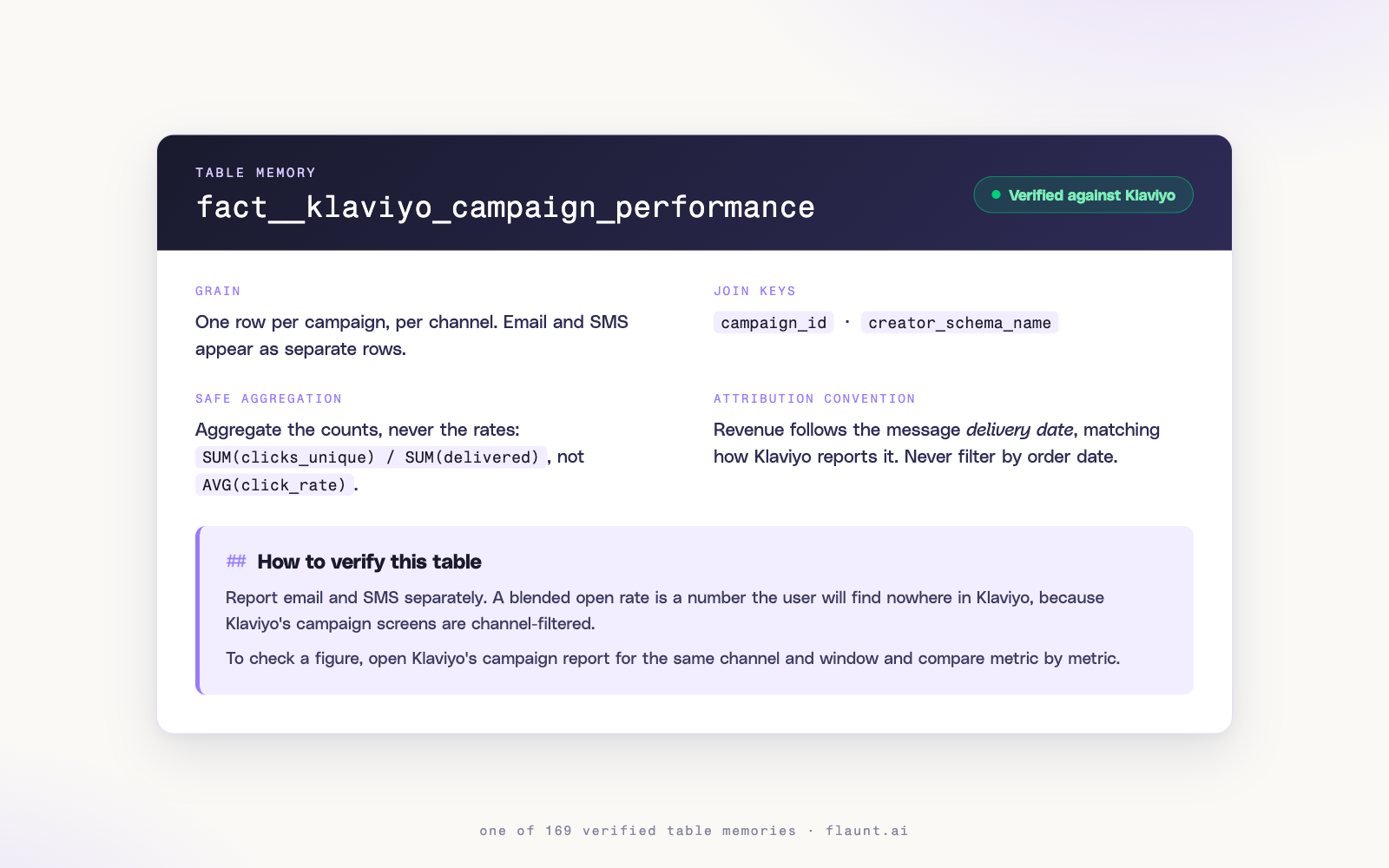
And third, the whole thing improves continuously. Retention marketers push on our analyst with hard questions every day. When a question can't be answered quickly and accurately, we fix the memory, and the fix ships to every brand.
The new search_memories tool hands all of this to your agent. Ask a question in your Claude, and before it touches any data, it reads the same context our own analyst reads. Same memory, same brand-specific notes, same guardrails.
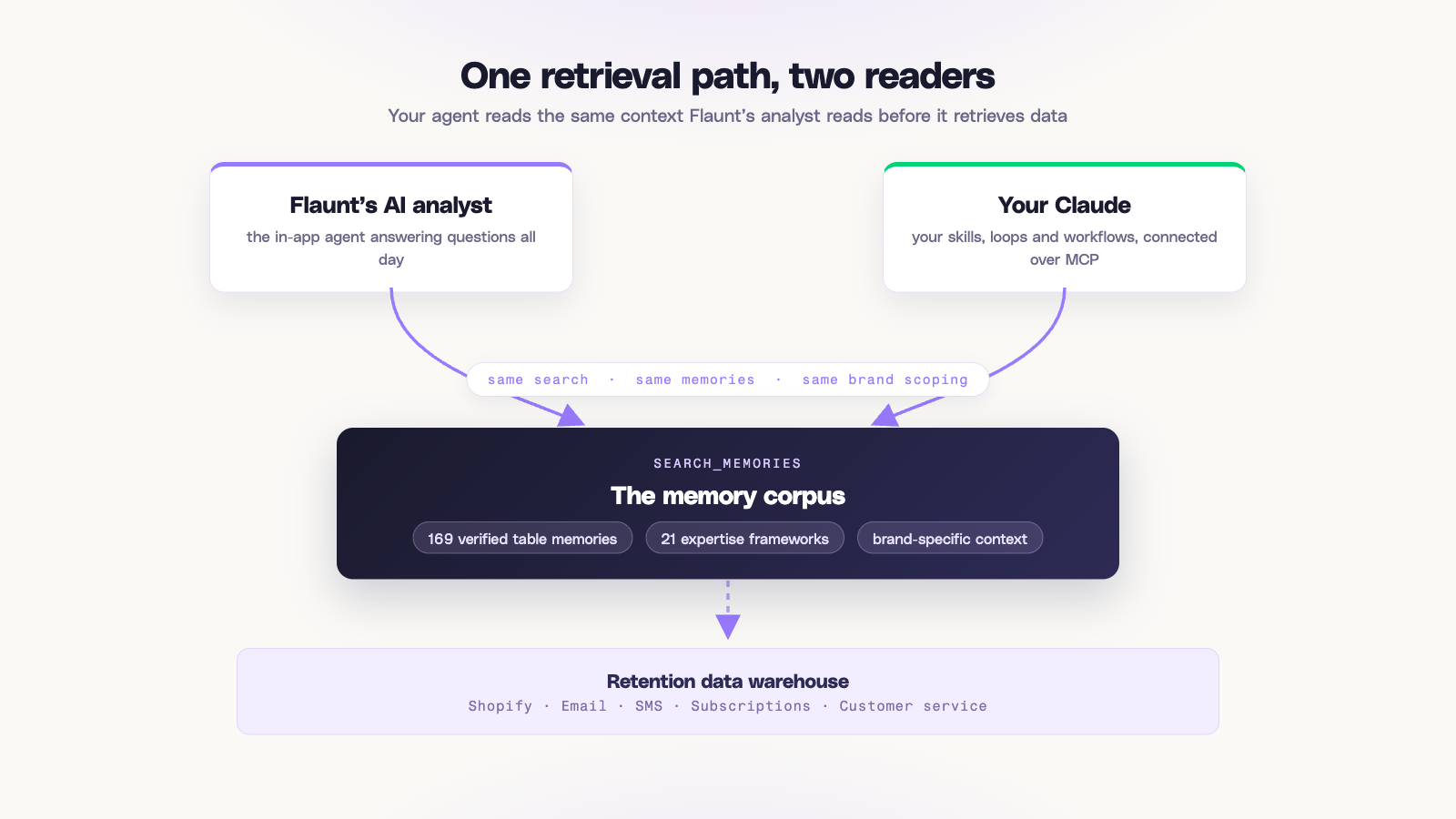
Piece two: our analyst's own playbook, adapted for your agent
The memory is what Flaunt knows. The system prompt is how Flaunt behaves: how it decides which tool to use, when to double-check a number, how to present results a strategist can act on and verify.
We've adapted it for the MCP server, and we're giving it away. Even if you never use Flaunt, it's a working reference for anyone building a retention analysis agent on Hiro, Triple Whale, Saras, a custom stack, whatever you run.
Why give it away? Because deeper, more accurate analysis makes better strategists. Better strategists get better results for brands, better experiences for customers, and less money spent on things that don't matter. That's the ecosystem we want to work in.
Steal these prompts
Steal these and uncover the deep insights that turn into new tests — the kind that move the needle, not the kind that reword a subject line. Each one pulls from several data sources at once, which is exactly what your platform dashboards can't do.
1. The cancel-moment autopsy (email + subscriptions + orders)
For every subscription cancelled in the last 90 days, show me which emails and SMS the customer touched in the five days before cancelling, and how long after the touch they cancelled. Rank our flows by how often they're the last touch before a cancel, next to how much revenue each flow gets credit for. If any flow is both a top revenue driver and a top cancel trigger, break down what that message says by subscriber lifecycle stage, and propose one change we could A/B against it, measured on retained subscribers at 60 and 90 days rather than immediate revenue.
This is the prompt that found a $450K/month problem for one brand: a rebill reminder that earns credit for the charge it fires before, while quietly triggering the cancel. That inversion is invisible inside any one platform.
2. The discount honesty check (orders + discount codes + subscription cohorts)
Take every subscriber who joined through a discount in the last 12 months and match them against subscribers who joined at full price in the same months. Compare how each group retains order-over-order at the same cohort age — don't compare young cohorts against mature ones. Then net it out: did the discounted cohorts generate enough extra retained revenue to cover what we gave away? Tell me which specific discount depths and entry offers earned their cost, which didn't, and design the holdout test that would settle the biggest open question.
Most discount reporting stops at redemption counts. This one forces the question a strategist actually owns: did the margin buy durable customers, or timing shifts?
3. The send-volume ceiling (email volume + engagement + repeat purchase + cancellations)
Chart our monthly email campaign volume over the last 12 months next to click rates, repeat-purchase rate, subscription starts, and subscription cancellations. As volume scaled, where did engagement per send start to fall, and did the extra sends bring incremental orders or just move the same orders around? Split it by engaged versus unengaged segments if the data supports it. Then give me the frequency-cap test you'd run: which segment, what cap, and what we'd measure to know within six weeks.
"Send more" is the default lever in every retention program. This tells you where it stops working for your brand, with the test to prove it.
4. The full-journey audit (browser + sessions + cohorts — the external-agent flex)
First, browse our store like a first-time visitor: landing page, best-selling product page, the subscribe-and-save option, cart, and checkout, and note every point where the subscription offer is unclear, buried, or missing. Then pull our Shopify sessions by landing page and traffic source, conversion by device, and cohort quality by first-order type, and reconcile the two: where are we paying for traffic that lands on pages with weak subscription presentation, and how do the customers from those pages retain compared to our best entry points? Rank the page-level fixes by the revenue attached to them, and give me the first test to run.
This one only works with an external agent: your Claude can browse the storefront and query the warehouse in the same conversation. Flaunt sees what happened; the browser sees why. No dashboard does both.
Setup takes a few minutes
Add a custom connector in Claude pointing at https://api.flaunt.xyz/v1/data/mcp, approve it with your Flaunt login, and you're connected: read-only, scoped to the brands you manage. Then work the way our analyst works: find your brand, search the memories before pulling any data, and run your question.
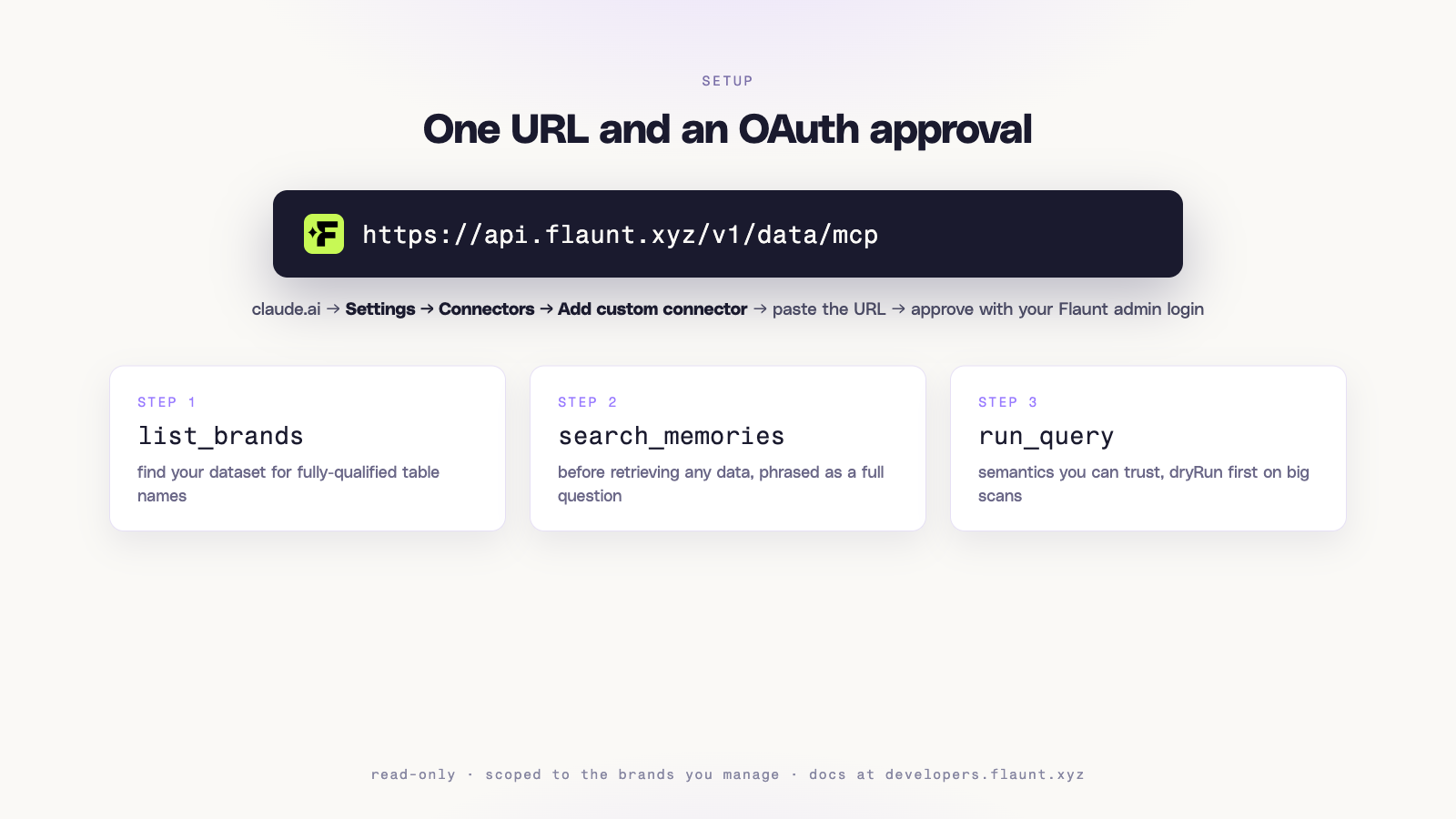
This is the first step in opening up Flaunt
Whatever makes our analyst accurate belongs in your agent's hands too. Full documentation lives at developers.flaunt.xyz. Want the system prompt? Message Connor on LinkedIn and he'll send it over with setup instructions. And if you'd rather see it running on your data first, book a demo.


